
Hindu Festivals · Ekadashi Vrat
Rama Ekadashi 2026: Date, Vrat Katha, Puja Vidhi and Significance
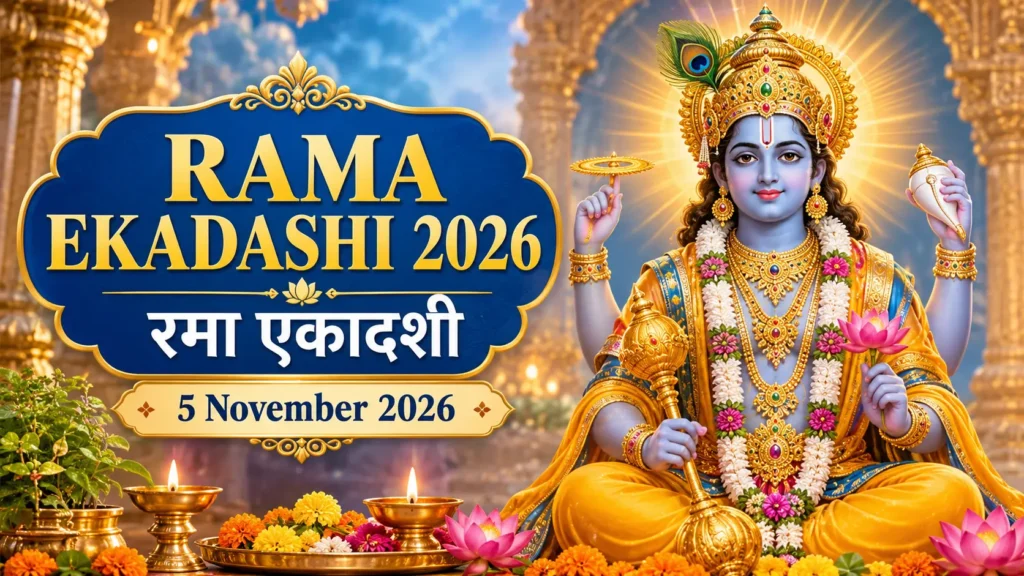
Rama Ekadashi will be observed on Thursday, 5 November 2026. Dedicated to Lord Vishnu in his Damodara form, this pre-Diwali Ekadashi is marked by prayer, fasting and the reading of the traditional Vrat Katha.
Rama Ekadashi 2026 Date and Timings
Rama Ekadashi, also known as Rambha Ekadashi, falls on Thursday, 5 November 2026. The Ekadashi Tithi begins on the previous day, but the fast is observed on 5 November because Ekadashi is present at local sunrise on that date.
| Festival | Rama Ekadashi (रमा एकादशी) |
|---|---|
| Paksha | Krishna Paksha |
| Tithi begins | Wednesday, 4 November 2026 – 11:03 AM IST |
| Tithi ends | Thursday, 5 November 2026 – 10:35 AM IST |
| Fasting date | Thursday, 5 November 2026 |
| Parana date | Friday, 6 November 2026 |
| Pune Parana window | 6:36 AM to 8:53 AM IST |
| Dwadashi ends | Friday, 6 November 2026 – 10:30 AM IST (Pune Panchang) |
Location note: The Parana window above is for Pune, Maharashtra. Parana timings can differ from city to city, so readers elsewhere should check a Panchang set for their own location. Tithi times are shown in Indian Standard Time (IST).
The Tithi's starting time is not the time when everyone must begin fasting. Ekadashi fasting dates are generally selected using the Tithi at local sunrise and the applicable observance rules. For Pune, Drik Panchang lists 5 November as the Rama Ekadashi fasting day.
What Is Rama Ekadashi?
Rama Ekadashi is observed on the eleventh lunar day, or Ekadashi, of the Krishna Paksha (the waning phase of the Moon) before Diwali. Devotees dedicate the day to Lord Vishnu and worship him in his Damodara form, a name especially associated with Lord Krishna.
The name can sometimes cause confusion, but Rama Ekadashi is not Ram Navami and it does not mark the birth of Lord Rama. It is a separate Vishnu-related fasting observance. It is also referred to as Rambha Ekadashi in some calendars and religious traditions.
You may see the lunar month named differently in different calendars. Calendars following the Purnimanta convention commonly call it Kartik Krishna Ekadashi, while Maharashtra's Amanta calendar convention identifies the same observance as Ashwin Krishna Ekadashi. The date in 2026 remains Thursday, 5 November.
Significance of Rama Ekadashi
For devotees of Lord Vishnu, Ekadashi is a day to step back from routine distractions and give more attention to prayer, self-discipline and reflection. On Rama Ekadashi, many worshippers offer prayers to Lord Vishnu or Damodara, listen to devotional readings and observe a fast according to their family practice.
Traditional Hindu accounts describe Rama Ekadashi as spiritually meritorious and associate its observance with the removal of past wrongs and the blessing of Lord Vishnu. These are religious beliefs and devotional teachings rather than claims that can be measured scientifically.
Because it comes in the run-up to Diwali, the day is also part of the season of worship and preparation observed by many Hindu households. The focus of the vrat, however, remains devotion to Lord Vishnu and observance of Ekadashi.
Rama Ekadashi Puja Vidhi
Rituals can vary between regions, temples and families. The following is a simple outline of practices followed by many devotees; it is not a requirement that every household perform each step in exactly the same way.
- Begin the day with personal preparation. Devotees who are observing the vrat may wake early, bathe and wear clean clothes. They prepare a clean place for worship at home.
- Take a Sankalp. A Sankalp is a personal resolve to observe the fast and spend the day in prayer. The form of the resolve may follow the devotee's family or religious tradition.
- Worship Lord Vishnu. Place an image or idol of Lord Vishnu or Damodara in the puja area. Offer prayers and traditional items such as flowers, fruit, a lamp and Tulsi leaves where these are part of the family's practice.
- Offer prayers or recite Vishnu's name. Devotees may chant a Vishnu mantra, read a prayer or simply repeat the Lord's name with devotion. Follow the practice familiar to your household or temple tradition.
- Read or listen to the Vrat Katha. Many families read the story of King Muchukunda, Chandrabhaga and Shobhana to remember the traditional teaching associated with Rama Ekadashi.
- Observe the fast according to your capacity. Some devotees abstain from food, while others take fruit, milk or permitted fasting foods. The choice should reflect personal health and family tradition.
- Complete the vrat on Dwadashi. On the following day, Friday, 6 November 2026, devotees perform Parana during the suitable local Panchang window and conclude the fast.
Rama Ekadashi Vrat Katha
The traditional Rama Ekadashi Vrat Katha tells the story of King Muchukunda, his daughter Chandrabhaga and her husband Shobhana. It is a devotional story shared to explain the significance of observing this Ekadashi.
King Muchukunda and Chandrabhaga
Long ago, King Muchukunda ruled a prosperous kingdom and was known for his devotion to Lord Vishnu. He observed Ekadashi with discipline, and the people of his kingdom followed the fast. His daughter Chandrabhaga was married to Shobhana, the son of another king.
Shobhana observes Rama Ekadashi
During one visit to Chandrabhaga's home, Shobhana arrived when Rama Ekadashi was being observed. He was physically weak and worried that he would not be able to complete the fast. Chandrabhaga explained the custom followed in her father's kingdom. Shobhana nevertheless chose to observe the vrat. In the traditional account, he became exhausted and died before the next sunrise.
The city of Devapura
The story says that, through the grace of Lord Vishnu and the merit associated with Rama Ekadashi, Shobhana received a splendid city named Devapura on Mount Mandarachala. A Brahmin named Soma Sharma later met Shobhana there and learned that the city was not yet stable because Shobhana's own observance had been reluctant rather than wholehearted.
Chandrabhaga's devotion
When Soma Sharma carried the news to Chandrabhaga, she wished to join her husband and help make the city lasting. The story describes her as a devoted observer of Ekadashi from a young age. With the help and blessings of the sage Vamadeva, she reached Shobhana, and the merit of her faithful observance was said to make Devapura stable. The katha concludes by praising sincere devotion to Lord Vishnu.
This is a traditional religious narrative, not a historical account or an instruction to undertake a fast beyond one's physical ability. Fasting practices should always be adapted to a person's health and circumstances.
Rama Ekadashi Fasting Rules and Food
There is no single fasting pattern followed by every devotee. Some observe a strict fast, while others choose a lighter form based on their health, age and family custom. Common forms include a water-only fast, a milk-based fast, a fruit-based fast or one permitted meal later in the day.
In many Ekadashi traditions, devotees avoid ordinary grains and cereals such as rice, wheat and pulses. Depending on local custom, fasting meals may include fruit, milk, nuts, potatoes, sweet potato, sabudana or water-chestnut flour. Rules for ingredients such as buckwheat flour and samak rice can differ, so check the practice followed by your family or spiritual tradition.
Some devotees also avoid onion, garlic and certain other foods as part of their household observance. These customs are not identical everywhere. When in doubt, follow guidance from a trusted family elder, temple or spiritual teacher.
Rama Ekadashi Parana on Dwadashi
Parana means breaking or completing the Ekadashi fast. It is generally performed on the following Dwadashi Tithi, after sunrise and within the appropriate time given by the local Panchang. For Rama Ekadashi in 2026, Parana falls on Friday, 6 November.
For Pune, Drik Panchang gives the Parana window as 6:36 AM to 8:53 AM IST on 6 November. The Pune Panchang lists Dwadashi ending at 10:30 AM that morning. These timings are for Pune and should not be copied as the Parana time for every city.
Traditional calculations also take Hari Vasara into account. Hari Vasara is the first quarter of Dwadashi, during which Parana is generally avoided. Devotees should follow the Parana period calculated for their location rather than choosing a time solely from a general online article.
Rama Ekadashi and the Diwali Season
Rama Ekadashi arrives during the days leading up to Diwali and is one of the observances many Hindu families include in their pre-Diwali calendar. It is followed by other regional and household traditions connected with the festival season. The exact sequence and names of these observances can vary across India.
Rama Ekadashi should be understood as a distinct Vishnu vrat, not as a Diwali puja itself. Its central practices are the Ekadashi fast, prayer, remembrance of Lord Vishnu and the reading of its traditional story.
Frequently Asked Questions
1. When is Rama Ekadashi in 2026?
Rama Ekadashi will be observed on Thursday, 5 November 2026. The Ekadashi Tithi begins on 4 November and ends on the morning of 5 November. The fast is observed on 5 November because Ekadashi is present at sunrise.
2. Which deity is worshipped on Rama Ekadashi?
Devotees worship Lord Vishnu, particularly in his Damodara form, which is associated with Lord Krishna. Prayers, Vishnu naam-jap and readings connected with the vrat are common parts of the observance.
3. What are the Rama Ekadashi Tithi timings in 2026?
For Pune, the Tithi begins at 11:03 AM IST on Wednesday, 4 November 2026, and ends at 10:35 AM IST on Thursday, 5 November. The fasting date is Thursday, 5 November.
4. When is Rama Ekadashi Parana in 2026?
Parana is on Friday, 6 November 2026. For Pune, the listed Parana window is 6:36 AM to 8:53 AM IST. Timings differ by location, so use the Panchang for your own city.
5. What is the significance of Rama Ekadashi?
Rama Ekadashi is a day of devotion to Lord Vishnu. Many devotees observe a fast, pray, practise self-discipline and listen to the Vrat Katha. Hindu tradition regards sincere observance as spiritually meritorious.
6. What can devotees eat during Rama Ekadashi?
Fasting customs vary. Depending on family tradition, devotees may take fruit, milk, nuts, potatoes, sabudana or other permitted vrat foods, while avoiding regular grains and pulses. Check local rules for ingredients that are treated differently by different traditions.
7. Can someone observe Rama Ekadashi without a strict fast?
Yes. Many devotees choose a lighter fast or simply focus on prayer according to their ability and tradition. People who are unwell, pregnant, elderly, taking medication or managing a medical condition should not attempt restrictive fasting without medical guidance.
8. Is Rama Ekadashi the same as Rambha Ekadashi?
Rambha Ekadashi is another name used for Rama Ekadashi in some calendars and traditions. It is a Krishna Paksha Ekadashi observed before Diwali and is dedicated to Lord Vishnu.
9. Is Rama Ekadashi related to Lord Rama or Ram Navami?
No. Rama Ekadashi is a separate Ekadashi vrat dedicated to Lord Vishnu in his Damodara form. It is not Ram Navami, the festival that celebrates the birth of Lord Rama.
10. What is the Rama Ekadashi Vrat Katha?
The traditional story features King Muchukunda, his daughter Chandrabhaga and her husband Shobhana. It describes the spiritual merit associated with the vrat and highlights Chandrabhaga's sincere devotion to Lord Vishnu.