
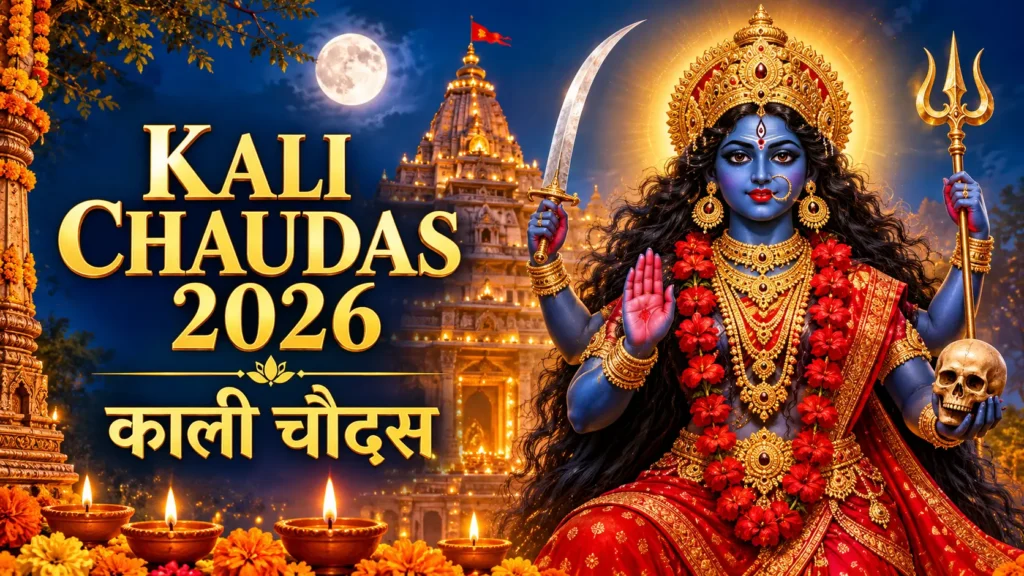
Kali Chaudas 2026: Date, Puja Muhurat, Significance and Rituals
Kali Chaudas is an important Hindu observance associated with Goddess Kali, devotion, courage and the traditional belief in overcoming negative forces. It is especially familiar in Gujarat and other parts of western India, where it forms part of the Diwali festive period. Devotees observe the occasion through prayers, traditional worship and family customs. In 2026, Kali Chaudas falls on Saturday, 7 November. Its connection with the midnight period makes the timing of the observance particularly important. The festival is also associated in popular tradition with Goddess Kali's victory over the demon Raktabija.
Kali Chaudas 2026 Date and Day
Kali Chaudas will be observed on Saturday, 7 November 2026. The festival is associated with Krishna Paksha Chaturdashi, the fourteenth lunar day of the waning fortnight in the Hindu lunar calendar.
| Festival Information | Details |
|---|---|
| Festival Name | Kali Chaudas (काली चौदस) |
| Date | 7 November 2026 |
| Day | Saturday |
| Hindu Month | Kartika |
| Paksha | Krishna Paksha |
| Relevant Tithi | Krishna Chaturdashi |
| Festival Year | 2026 |
| Main Association | Worship of Goddess Kali |
The date is selected according to the traditional rule that gives importance to Chaturdashi being present during Nishita Kaal, the midnight period. This is one reason Kali Chaudas and Narak Chaturdashi can be listed on different dates in the same year.
Calendar note: Hindu lunar dates can depend on the observance rule and the location-specific Panchang. The date above refers to the Kali Chaudas midnight observance, not a universal date for every related Diwali ritual.
Kali Chaudas 2026 Puja Muhurat and Tithi Timings
Kali Chaudas worship is traditionally connected with Nishita Kaal, the middle portion of the night. During this period, devotees who follow the relevant tradition offer prayers to Goddess Kali.
Mumbai Kali Chaudas Muhurat 2026
| Timing Details | Date and Time |
|---|---|
| Chaturdashi Tithi Begins | 7 November 2026, 10:47 AM |
| Chaturdashi Tithi Ends | 8 November 2026, 11:27 AM |
| Kali Chaudas Nishita Puja | 7 November, 11:57 PM – 8 November, 12:48 AM |
| Reference City | Mumbai, Maharashtra, India |
| Time Zone | Indian Standard Time (IST) |
These timings are based on the Mumbai Panchang calculation. The Nishita Puja period begins late on Saturday night and continues shortly after midnight on Sunday, 8 November.
Why Is Nishita Kaal Important?
Nishita Kaal refers to the middle portion of the night and has special importance in certain Hindu worship traditions. Kali Chaudas is associated with this period because the observance is traditionally selected when Chaturdashi Tithi is present at midnight.
Devotees who follow this custom consider the period suitable for their traditional prayers to Goddess Kali. The exact worship method depends on family and regional practices.
Important: The timings above are specifically for Mumbai. Panchang calculations and Muhurat can differ between cities. Readers should check a local Panchang for their own location before planning religious activities.
What Is Kali Chaudas?
Kali Chaudas is a Hindu religious observance associated with Goddess Kali. It is especially popular in Gujarat and is also recognized in parts of Rajasthan and Maharashtra. The occasion is part of the wider Diwali celebration period.
The name is made up of two words. Kali refers to Goddess Kali, a powerful form of the Divine Mother in Hindu tradition. Chaudas refers to the fourteenth lunar day, or Chaturdashi, of the fortnight.
The festival is therefore connected with the worship of Goddess Kali on Krishna Chaturdashi. In some traditions, it is also called Bhut Chaturdashi. The names and customs associated with the observance can vary according to region.
For many devotees, this day is an opportunity to offer prayers for courage, protection, strength and spiritual well-being.
Why Is Kali Chaudas Celebrated?
Kali Chaudas is observed as a day of devotion to Goddess Kali. In Hindu tradition, Goddess Kali represents powerful divine energy and the strength to overcome destructive forces.
The observance is associated with several traditional beliefs:
- Seeking divine protection: Devotees pray for the well-being and safety of their families.
- Remembering divine strength: Goddess Kali is worshipped as a powerful form of Shakti.
- Overcoming fear: The occasion reminds devotees to face difficulties with courage.
- Spiritual reflection: Prayers encourage people to turn away from harmful thoughts and actions.
- Following family traditions: Many households continue customs passed down through generations.
The festival is also connected with the traditional story of Goddess Kali defeating Raktabija. This story is remembered as an example of divine power overcoming a seemingly unstoppable force.
Mythological Story Behind Kali Chaudas
One story associated with Kali Chaudas is the battle between Goddess Kali and the demon Raktabija. The account appears in the Devi Mahatmya, an important text associated with the worship of the Divine Mother.
Who Was Raktabija?
Raktabija was a powerful demon who possessed an unusual ability. According to the traditional story, every drop of his blood that touched the ground produced another demon similar to him.
This made him extremely difficult to defeat. The more the divine forces attacked him, the more opponents appeared from the blood falling on the battlefield.
How Did Goddess Kali Defeat Raktabija?
The Divine Mother recognized that Raktabija could not be defeated through ordinary attacks. She called upon Goddess Kali, also known in this episode as Chamunda, to help stop the spread of the demon's blood.
Kali extended her mouth and caught the blood before it could reach the ground. She also consumed the demons that emerged from the blood. With no new demons appearing, the divine forces were finally able to defeat Raktabija.
What Does This Story Symbolize?
The story is traditionally understood as a reminder that destructive forces must be addressed at their source. It also represents the power of the Divine Mother and the victory of divine strength over evil.
The Raktabija episode is part of the Devi Mahatmya narrative. Its association with Kali Chaudas is a traditional festival connection; readers should not assume that every regional Kali Chaudas custom follows exactly the same story or ritual.
How Is Kali Chaudas Celebrated?
Kali Chaudas is observed through different traditions depending on the region and household. In Gujarat, worship of Goddess Kali is an important part of the occasion.
Some common forms of observance include:
- Offering prayers to Goddess Kali.
- Lighting traditional lamps in the home.
- Visiting temples and participating in devotional activities.
- Offering flowers and other customary items during worship.
- Reciting familiar prayers or devotional verses.
- Following traditional family customs associated with Diwali.
Some regional traditions associate Kali Chaudas with Hanuman worship as well. However, not every family or community follows the same customs.
The midnight association is particularly important in traditions that observe Kali Chaudas according to Nishita Kaal.
Kali Chaudas Rituals and Puja Vidhi
The method of worship can differ between communities. Families usually follow their own customs or the guidance of their temple and religious tradition. The following is a simple outline of household worship, not a substitute for a specific traditional ritual procedure.
1. Prepare the Puja Area
Clean the place where the worship will take place. Arrange the picture or idol of Goddess Kali in a suitable and respectful place.
2. Arrange Traditional Puja Items
Keep commonly used items ready, such as flowers, a diya, incense, a clean cloth and customary offerings. The exact items depend on family tradition.
3. Begin With Prayer
Sit comfortably and begin the worship with a prayer according to your household tradition. Devotees may offer a simple prayer expressing respect and gratitude to Goddess Kali.
4. Offer Flowers and Prasad
Offer fresh flowers and suitable prasad according to the customs followed by your family or temple.
5. Light a Diya
Light a traditional lamp in a stable and safe place. Keep it away from curtains, paper, decorations and other flammable materials.
6. Recite Prayers
Devotees may recite prayers, devotional verses or a familiar hymn dedicated to Goddess Kali. Those unfamiliar with a formal prayer can offer a sincere prayer in their own language.
7. Complete the Worship
Conclude the worship respectfully and distribute prasad among family members. Follow any additional regional or family customs that are part of your tradition.
Safety reminder: Avoid unsafe fire practices, hazardous substances, animal harm or unverified ritual instructions. A simple, respectful household prayer is an appropriate way for families to observe the occasion.
Difference Between Kali Chaudas and Narak Chaturdashi
Kali Chaudas and Narak Chaturdashi are often mentioned together during Diwali. However, they have different traditional associations and can follow different observance rules.
| Basis | Kali Chaudas | Narak Chaturdashi |
|---|---|---|
| Main Association | Goddess Kali and divine protection | Lord Krishna's victory over Narakasura |
| Traditional Story | Goddess Kali and Raktabija | Lord Krishna and Narakasura |
| Main Observance | Midnight worship during Nishita Kaal in relevant traditions | Abhyanga Snan and associated pre-dawn observances |
| Associated Deity | Goddess Kali | Lord Krishna |
| Regional Recognition | Especially associated with Gujarat and western India | Widely observed across India |
| Observance Rule | Chaturdashi present during the relevant midnight period | Chaturdashi present during the relevant pre-dawn moonrise observance |
Why Can Their Dates Be Different?
The difference comes from the traditional rules used to select the observance date. Kali Chaudas is associated with Chaturdashi during Nishita Kaal, while Narak Chaturdashi is associated with the pre-dawn observance, including Abhyanga Snan.
In 2026, the Mumbai Panchang lists Kali Chaudas on Saturday, 7 November. The associated Narak Chaturdashi pre-dawn observance is on Sunday, 8 November. This is why readers should check the particular festival observance rather than relying only on a general Diwali calendar.
Remember: Kali Chaudas, Narak Chaturdashi, Roop Chaudas and Kali Puja are related to the Diwali period, but their traditional significance and observance rules are not identical.
Regional Significance of Kali Chaudas in India
Although Kali Chaudas is connected with the wider Diwali festival, its popularity and rituals vary across India. Gujarat has a particularly strong association with this observance.
Kali Chaudas in Gujarat
Gujarat is one of the main regions where Kali Chaudas is observed. Devotees associate the day with the worship of Goddess Kali, traditional prayers and customs for protection and well-being. The observance forms part of the Diwali festivities followed by many Gujarati families.
Kali Chaudas in Maharashtra
In Maharashtra, Kali Chaudas is recognized within the wider Diwali celebration period. The customs followed can differ between communities and households. Some families give particular attention to the related Narak Chaturdashi traditions and pre-dawn rituals.
Kali Chaudas in Rajasthan
Kali Chaudas is also known in parts of Rajasthan. Devotional practices and family customs may include prayers and traditional worship during the Diwali period.
Other Regional Traditions
Different parts of India have their own ways of observing the days around Diwali. Some traditions emphasize the worship of Goddess Kali, while others focus on Lord Krishna's victory over Narakasura, early morning bathing customs or the worship of Kali on Amavasya.
These regional differences are an important part of India's cultural diversity. A festival name may be shared between regions even when the rituals are not exactly the same.
Spiritual Significance of Kali Chaudas
Beyond the rituals, Kali Chaudas holds symbolic meaning for devotees. Goddess Kali is traditionally associated with strength, courage and the destruction of harmful forces.
Strength and Courage
The worship of Goddess Kali reminds devotees to face difficult situations with determination and inner strength.
Protection and Devotion
Prayers offered on this occasion express the hope for protection and well-being. For many households, the observance is also a way to maintain devotion and continue inherited religious customs.
Overcoming Fear
Goddess Kali's powerful form is often understood as a symbol of facing fear rather than allowing it to control one's life.
Awareness and Positive Change
The festival also offers a moment for reflection. Devotees can use the occasion to think about harmful habits, negative thoughts and the importance of acting with compassion and courage.
Traditional Food and Preparations During Kali Chaudas
There is no single food item that is universally prescribed for Kali Chaudas across India. Food customs generally follow the wider Diwali traditions of a particular family or region.
In Gujarat and Maharashtra, households may prepare or share festive snacks and sweets as part of the Diwali season. Depending on family customs, these can include items such as chakli, chivda, shankarpali, karanji and traditional sweets.
Some devotees may also choose simple or customary food according to their personal fasting and worship practices. These choices are not identical for everyone.
Families should follow their own dietary and religious customs rather than assume that one particular dish is required for Kali Chaudas.
How to Celebrate Kali Chaudas at Home
People who cannot visit a temple can still observe Kali Chaudas through simple and meaningful household activities.
- Prepare a clean worship space: Arrange a suitable place for a picture or idol of Goddess Kali.
- Offer a simple prayer: Spend a few quiet moments in devotion and gratitude.
- Light a traditional diya safely: Place the lamp on a stable surface away from flammable materials.
- Offer flowers or prasad: Follow the customs commonly observed by your family.
- Learn about the festival: Read about Goddess Kali and the traditional story of Raktabija.
- Spend time with family: Share the meaning of the festival with children and younger family members.
- Exchange greetings: Send thoughtful Kali Chaudas wishes to friends and relatives.
A peaceful celebration based on devotion, family traditions and cultural understanding can make the occasion meaningful.
Kali Chaudas 2026 Wishes and Messages
Share these simple and thoughtful Kali Chaudas wishes with your friends, family and loved ones.
Frequently Asked Questions About Kali Chaudas 2026
1. When is Kali Chaudas in 2026?
Kali Chaudas will be observed on Saturday, 7 November 2026. The observance is associated with Krishna Chaturdashi during Nishita Kaal, according to the relevant tradition.
2. Why is Kali Chaudas celebrated?
Kali Chaudas is celebrated in devotion to Goddess Kali. It is traditionally associated with protection, courage, spiritual strength and the victory of divine power over destructive forces.
3. Which Goddess is worshipped on Kali Chaudas?
Goddess Kali, a powerful form of the Divine Mother or Shakti, is the main deity associated with Kali Chaudas.
4. What is the significance of Kali Chaudas?
The festival symbolizes courage, protection, devotion and overcoming negative influences. It is also connected with the traditional story of Goddess Kali defeating the demon Raktabija.
5. Is Kali Chaudas the same as Narak Chaturdashi?
They are related Diwali-period observances but are not necessarily identical. Kali Chaudas is associated with Goddess Kali and midnight worship, while Narak Chaturdashi is associated with Lord Krishna's victory over Narakasura and pre-dawn rituals.
6. What is the importance of Nishita Kaal on Kali Chaudas?
Nishita Kaal is the middle period of the night. In the tradition used to determine Kali Chaudas, Chaturdashi must be present during this period for the midnight observance.
7. How is Kali Chaudas celebrated in Gujarat?
In Gujarat, devotees commonly associate Kali Chaudas with worship of Goddess Kali, traditional prayers and family customs during the Diwali season. Practices can differ between households.
8. What are the traditional Kali Chaudas rituals?
Common household practices include arranging a worship space, offering flowers, lighting a diya, praying to Goddess Kali and following customary family rituals. Regional practices may differ.
9. Can Kali Chaudas Puja be performed at home?
Yes. Devotees can offer simple household prayers to Goddess Kali. They can follow their family tradition, light a diya safely and offer flowers or prasad.
10. What is the difference between Kali Chaudas and Kali Puja?
Kali Chaudas is associated with Krishna Chaturdashi and the midnight observance in western Indian traditions. Kali Puja, especially in Bengal, is associated with the worship of Goddess Kali on Amavasya night. Their traditional calendar rules and regional practices are different.
Explore More Festivals and Calendars
Kali Chaudas is one part of the wider Diwali celebration period. You can also explore the Diwali 2026, Narak Chaturdashi 2026 and Kali Puja 2026 guides to understand the related traditions.
For more Hindu religious dates, see the Hindu Festivals and Hindu Vrat and Fasting Calendar. You can also browse the Festival Calendar 2026 for upcoming celebrations.
Conclusion
Kali Chaudas is a meaningful Hindu observance that brings attention to the strength and protective qualities associated with Goddess Kali. Celebrated particularly in Gujarat and other parts of western India, it is an important part of the Diwali festive period.
In 2026, Kali Chaudas falls on Saturday, 7 November. Its connection with Nishita Kaal and the traditional story of Raktabija gives the occasion its distinctive religious significance.
Whether observed through household prayers, temple visits or family traditions, Kali Chaudas offers devotees an opportunity to reflect on courage, faith and the triumph of good over destructive forces.
Disclaimer: Festival dates, tithi timings, puja muhurat and rituals can vary according to geographical location, Panchang calculations and regional religious traditions. The timings in this article are specifically identified by reference city. Readers should consult their local Panchang or family religious tradition for location-specific guidance. This article is intended for general informational and cultural purposes.