Choti Diwali 2026: Date, Naraka Chaturdashi Rituals and Significance
Choti Diwali, popularly associated with Naraka Chaturdashi, is an important part of India's Diwali celebrations. In 2026, Chaturdashi Tithi begins on Saturday, 7 November, while the principal sunrise-based Naraka Chaturdashi observance and Abhyang Snan fall on Sunday, 8 November. This unusual calendar overlap also brings the main Diwali celebrations onto 8 November. Here is what to know about the dates, timings, traditional rituals and story behind the festival.
Choti Diwali 2026: Important Dates and Details
The festival's timing is connected to Krishna Paksha Chaturdashi, the fourteenth lunar day of the waning fortnight. Since this Tithi continues from 7 November into 8 November, it is important to understand both dates before planning traditional observances.
All times are Indian Standard Time (IST). The Tithi and ritual timings shown here follow the referenced Drik Panchang calculations. Regional Panchang conventions may give different interpretations.
Why Are Choti Diwali and Naraka Chaturdashi Dates Different in 2026?
The difference comes from the way Hindu lunar dates are assigned to a civil calendar. A Tithi is not the same as a midnight-to-midnight date. It can begin at any time and continue into the following day.
In 2026, Krishna Chaturdashi begins at 10:47 AM on 7 November and ends at 11:27 AM on 8 November. Therefore, the lunar period covers parts of both Saturday and Sunday.
Under the sunrise-based Panchang convention used by Drik Panchang for Naraka Chaturdashi, the Tithi prevailing at sunrise on 8 November determines the observance. That is why the pre-dawn Abhyang Snan is listed for Sunday, 8 November.
Some festival listings instead use the date on which Chaturdashi begins and consequently print 7 November. Kali Chaudas, which is associated with a midnight observance during Chaturdashi, also falls on the night of 7 November in this calendar arrangement.
Abhyang Snan 2026: Date and City-Wise Muhurat
Abhyang Snan is a traditional early-morning bath performed with an application of oil. It is an important ritual associated with Naraka Chaturdashi. Many families apply sesame oil and use a traditional ubtan before bathing. The practice is connected with purification and the symbolic removal of negativity before the festival.
The bath is traditionally performed before sunrise during the prescribed Chaturdashi period. The suitable window is calculated according to local astronomical timings, which is why the Muhurat can differ from one city to another.
Abhyang Snan Muhurat on 8 November 2026
| City | Date | Abhyang Snan Muhurat |
|---|---|---|
| Pune | Sunday, 8 November | 5:40 AM – 6:37 AM |
| Mumbai | Sunday, 8 November | 5:45 AM – 6:42 AM |
| New Delhi | Sunday, 8 November | 5:41 AM – 6:38 AM |
These are location-specific example timings, not universal timings for every Indian city. Always confirm the Muhurat for the place where the ritual will be performed.
Those who want to understand traditional auspicious time windows can also explore the Shubh Muhurat Calculator on TodayFestival.com. It provides general candidate windows and approximate Panchang indicators; it does not currently calculate a validated Naraka Chaturdashi-specific Abhyang Snan Muhurat.
What Is Choti Diwali?
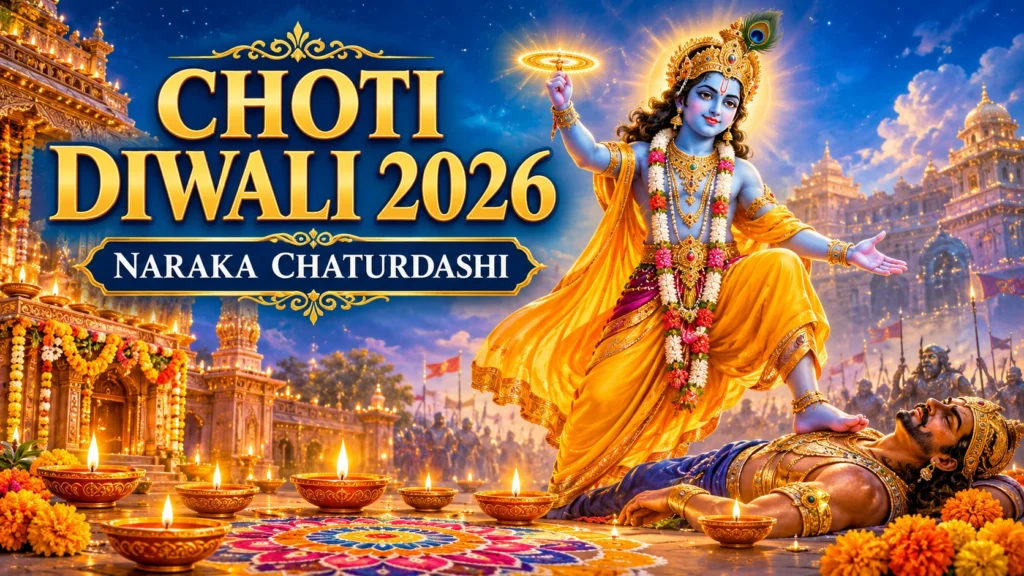
Choti Diwali literally means Small Diwali. It is commonly associated with Naraka Chaturdashi, an important day in the five-day Diwali festival period. The occasion is linked to the traditional story of Lord Krishna defeating Narakasura and freeing those held captive by him.
The festival is known by different names in different communities. Narak Chaturdashi is another widely used name. Roop Chaudas is associated with traditional bathing and personal care customs, while Kali Chaudas refers to regional observances connected with Goddess Kali. The names can overlap, but they do not always describe identical rituals.
Choti Diwali is also a time when families prepare their homes for the wider Diwali celebrations. Traditional lamps, rangoli, festive food and prayers make the occasion special.
The Story of Narakasura and Lord Krishna
The religious story behind Naraka Chaturdashi is found in Hindu Puranic tradition. According to the account in the Bhagavata Purana, Narakasura, also known as Bhaumasura, was a powerful ruler who became oppressive and took what belonged to others.
Among his misdeeds, he stole the earrings of Aditi, the mother of the gods, and held thousands of women captive. When the gods sought help, Lord Krishna set out to defeat Narakasura.
In the traditional account in the Bhagavata Purana, Krishna travelled with his wife Satyabhama on Garuda and defeated Narakasura in battle. He then freed the women who had been imprisoned and restored the stolen possessions.
Some regional retellings give Satyabhama a particularly important role in the final moments of the battle. In these versions, she delivers the decisive blow because of a boon connected with Narakasura's mother, Bhudevi. Details differ between tellings, and this should not be confused with the precise sequence in every scriptural version.
The central message of the story is the victory of righteousness over cruelty. It gives Naraka Chaturdashi its association with freedom, courage and the removal of darkness.
Why Is Choti Diwali Celebrated?
Choti Diwali carries a message that goes beyond the story of a battle. For devotees, it is a reminder that negative qualities such as arrogance, cruelty and injustice should not be allowed to prevail.
The lighting of diyas represents the movement from darkness towards light. Traditional bathing rituals are associated with physical and spiritual cleanliness, while prayers provide an opportunity to reflect on personal values and begin the main Diwali celebrations with a positive outlook.
Families also use the occasion to spend time together, prepare festive food and welcome the coming festival with warmth and devotion.
Choti Diwali Rituals and Traditions
1. Early Morning Abhyang Snan
Many households begin Naraka Chaturdashi with an early bath before sunrise. The ritual is traditionally regarded as an act of purification and is one of the best-known customs of this festival.
2. Applying Oil and Traditional Ubtan
In several communities, sesame oil is applied before bathing. Traditional ubtan preparations may contain ingredients such as gram flour, turmeric and herbs. The exact preparation differs between families and regions.
3. Prayers and Devotion
Devotees remember Lord Krishna and the victory over Narakasura. Families may perform a small puja or offer prayers according to their household customs.
4. Lighting Traditional Diyas
Small oil lamps are lit in homes, courtyards and entrances. Diyas are a familiar symbol of Diwali and represent hope, positivity and the triumph of light over darkness.
5. Cleaning and Decorating the Home
Families clean their homes and prepare the prayer area. Decorative lights, flowers and traditional ornaments are used to create a welcoming festive atmosphere.
6. Making Rangoli
Colourful rangoli designs are created near entrances and in courtyards. Some households use flowers, coloured powders or rice flour to make traditional patterns.
7. Preparing and Sharing Sweets
Homemade sweets and savoury snacks are prepared for family members and guests. Sharing festive food remains an important part of the celebrations.
8. Family Gatherings and Evening Prayers
Families come together for prayers, decorations and the final preparations for Diwali. Some communities also observe traditional lamp rituals associated with Lord Yama.
9. Regional Kali Chaudas Customs
In parts of Gujarat and Rajasthan, Kali Chaudas is associated with worship and regional practices connected with Goddess Kali. Traditions differ, and these observances should not be treated as identical across India.
10. Community Celebrations
In some places, celebrations include community prayers, cultural programmes and traditional representations of Narakasura. These activities help bring neighbours and families together.
How Is Choti Diwali Celebrated in Different Parts of India?
North India
In many North Indian households, Choti Diwali is associated with an early morning bath, the lighting of lamps and preparations for Lakshmi Puja. Families decorate their homes and prepare sweets before the main celebration.
Maharashtra
Abhyanga Snan is an especially familiar part of Diwali celebrations in Maharashtra. Families traditionally apply oil and ubtan before bathing and then enjoy Diwali faral, which may include chakli, chivda, karanji and ladoos. Certain local customs also include the symbolic crushing of the bitter karit fruit.
Gujarat and Rajasthan
Kali Chaudas and Roop Chaudas are important regional names associated with this period. Customs may include traditional bathing, prayers, worship associated with Goddess Kali and preparations for Lakshmi Puja.
South India
In Tamil Nadu, Karnataka and Andhra Pradesh, Naraka Chaturdashi is an important part of Deepavali celebrations. Families commonly wake before sunrise, take a traditional oil bath, wear new clothes, offer prayers and share special foods.
Goa
Narakasura-themed community celebrations are a distinctive feature of Diwali in Goa. In some places, people create large effigies representing the demon and burn them as part of the festival celebrations.
These examples show how one festival period can carry different names and practices across the country. Local customs should be understood in their own cultural context.
Choti Diwali vs Main Diwali: What Is the Difference?
Choti Diwali and Badi Diwali are generally connected with two different lunar observances. Naraka Chaturdashi is associated with Krishna Paksha Chaturdashi, while the main Diwali celebration and Lakshmi Puja are associated with Amavasya.
| Details | Choti Diwali | Main Diwali |
|---|---|---|
| Religious association | Naraka Chaturdashi | Amavasya and Lakshmi Puja |
| Traditional date sequence | Before main Diwali | Main festival day |
| Mythological association | Defeat of Narakasura | Different traditions, including worship of Goddess Lakshmi and the return of Lord Rama |
| Common rituals | Abhyang Snan, prayers and lamps | Lakshmi-Ganesha Puja, diyas and family celebrations |
| 2026 observance | 8 November, early morning | 8 November, evening |
The 2026 calendar is unusual because the early-morning Naraka Chaturdashi observance and evening Lakshmi Puja fall on the same civil date. Their religious significance and ritual timings remain different.
Traditional Food and Festive Preparations
Food is an important part of the Diwali period. Families prepare sweets and savoury snacks to share with relatives, friends and visitors.
In Maharashtra, Diwali faral commonly includes chakli, chivda, karanji, ladoos and shankarpali. In South India, households may prepare dishes such as adhirasam and murukku. Other regions have their own sweets, snacks and festive recipes.
Preparing and sharing food is not just about the menu. It is also a way for families to preserve regional recipes and continue traditions across generations.
How Can Families Celebrate Choti Diwali Responsibly?
A few simple precautions can make celebrations safer and more comfortable for everyone. Keep traditional diyas on stable, heat-resistant surfaces and away from curtains, paper decorations and other flammable materials. Never leave burning lamps unattended.
Keep electrical decorations properly installed, supervise children around flames and fireworks, and follow local rules on firecrackers. Avoid excessive noise and unnecessary waste. Families can also choose traditional lamps and reusable decorations to make their celebrations more thoughtful.
Check Panchang Details for Your Location
Hindu calendar timings can differ by city because sunrise, sunset and other astronomical events depend on location. Tithi, Nakshatra, Yoga and Karana are also important elements used in traditional Panchang calculations.
Readers can explore these calendar elements using the Hindu Panchang Calculator on TodayFestival.com. It provides approximate, location-based Panchang information, including Tithi, Nakshatra, Yoga, Karana and local Sun and Moon timings.
For important religious ceremonies, compare the results with a trusted local Panchang and the customs followed by your family. An online calculator should be treated as an information tool rather than a certified religious almanac.
Conclusion
Choti Diwali is a meaningful part of the wider Diwali festival, bringing together traditions of purification, devotion and the victory of good over evil. Its association with Lord Krishna and Narakasura gives Naraka Chaturdashi a special place in Hindu culture.
In 2026, the Chaturdashi Tithi begins on 7 November, while the sunrise-based Naraka Chaturdashi Abhyang Snan observance falls on 8 November. The main Lakshmi Puja also takes place on 8 November, making this an unusual calendar arrangement.
Whether celebrated through a traditional oil bath, prayers, lighting diyas or sharing festive food, the occasion is a reminder to welcome positivity and celebrate together.
At TodayFestival.com, our aim is to help readers understand Indian and global festivals, their dates, cultural traditions and significance. Celebrate every moment with knowledge and respect for the traditions that make every festival special.
Frequently Asked Questions About Choti Diwali 2026
1. When is Choti Diwali in 2026?
Choti Diwali is associated with Naraka Chaturdashi. In 2026, the Chaturdashi Tithi begins on 7 November, while the sunrise-based Naraka Chaturdashi observance and Abhyang Snan fall on Sunday, 8 November. Some calendars list 7 November because the Tithi begins that day.
2. Is Choti Diwali on 7 or 8 November in 2026?
Both dates appear in published festival listings. The Tithi begins on Saturday, 7 November, but continues until Sunday, 8 November. Drik Panchang lists the sunrise-based Naraka Chaturdashi observance and its Abhyang Snan for 8 November.
3. When does Naraka Chaturdashi Tithi begin and end in 2026?
According to the referenced Drik Panchang timings, Krishna Chaturdashi begins at 10:47 AM IST on 7 November 2026 and ends at 11:27 AM IST on 8 November 2026. Check a local Panchang for any regional calculation differences.
4. When is Abhyang Snan on Naraka Chaturdashi 2026?
The referenced sunrise-based observance places Abhyang Snan on Sunday, 8 November 2026. The example Muhurat is 5:40 AM to 6:37 AM in Pune, 5:45 AM to 6:42 AM in Mumbai and 5:41 AM to 6:38 AM in New Delhi.
5. Why is Choti Diwali also known as Naraka Chaturdashi?
The festival is associated with Lord Krishna's defeat of Narakasura, a powerful ruler who oppressed others and imprisoned people. The story represents the victory of righteousness over evil, which is why the day is known as Naraka Chaturdashi.
6. What is the story of Lord Krishna and Narakasura?
According to the Bhagavata Purana, Lord Krishna defeated Narakasura and freed thousands of imprisoned women. Queen Satyabhama accompanied Krishna in the battle. Regional versions give her different roles in the final defeat.
7. What is the difference between Choti Diwali and Badi Diwali?
Choti Diwali is associated with Naraka Chaturdashi and the story of Krishna defeating Narakasura. Badi Diwali is the main Amavasya celebration, widely associated with Goddess Lakshmi's worship. In 2026, the principal rituals fall on the same civil date, 8 November.
8. Why is Abhyang Snan performed before sunrise?
Abhyang Snan is a traditional pre-dawn oil bath connected with purification and the religious observance of Naraka Chaturdashi. The prescribed window is determined according to the relevant Tithi and local astronomical timings, so it varies from city to city.
9. Is Kali Chaudas the same as Choti Diwali?
Kali Chaudas and Naraka Chaturdashi are associated with Krishna Chaturdashi, but their names and rituals vary by region. Some communities use the names interchangeably, while others observe distinct customs or associate Kali Chaudas with a midnight observance.