Gold
Some families buy a small coin, jewellery or another gold item as a symbol of prosperity. A large purchase is not necessary.

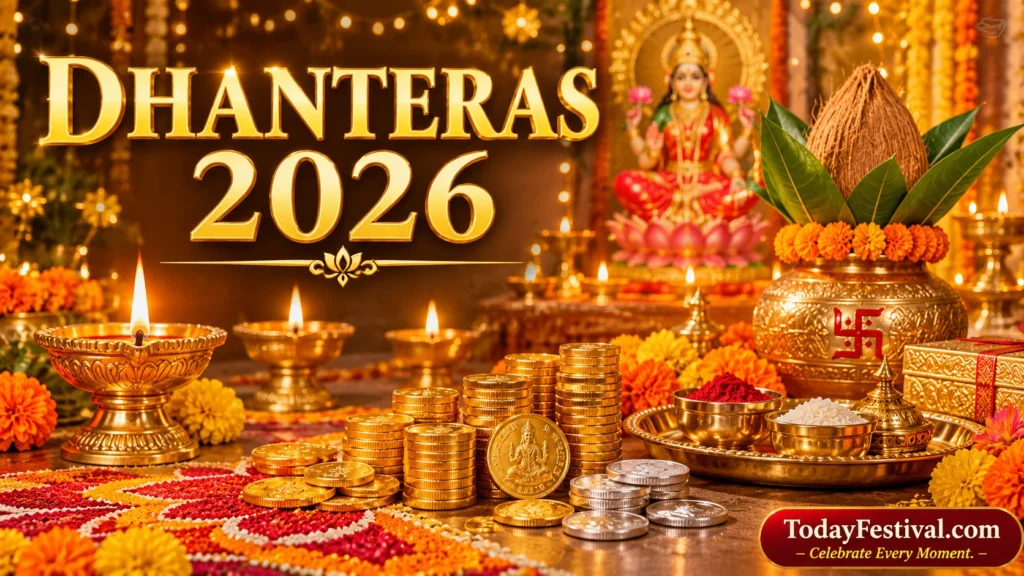
DHANTERAS 2026
Dhanteras will be observed on Friday, 6 November 2026. Here is the date, city-wise Puja Muhurat, Trayodashi Tithi, the meaning of Yama Deepdaan and the shopping customs followed by families across India.
MARK YOUR CALENDAR
All timings above are for New Delhi and are shown in Indian Standard Time (IST). Muhurat changes by location; check the city-wise table below before planning your puja.
Dhanteras, also called Dhantrayodashi, falls on Friday, 6 November 2026. It is observed on the Trayodashi (thirteenth) tithi of Krishna Paksha. In the Purnimanta calendar this is Kartika Krishna Trayodashi; calendars following the Amanta month system may refer to the same tithi as Ashwin Krishna Trayodashi.
For New Delhi, the Trayodashi Tithi begins at 10:30 AM on 6 November and ends at 10:47 AM on 7 November. The main Dhanteras Puja Muhurat listed for New Delhi is 6:02 PM to 7:57 PM on 6 November. The evening window combines Pradosh Kaal with Vrishabha, the fixed-sign period used in this calculation.
Pradosh Kaal is the evening period after sunset. The Puja Muhurat is a more specific window and should not be confused with the full Pradosh period or with a separate gold-shopping muhurat. For another location, check the Shubh Muhurat Calculator and use the city for which you need the timing.
The tithi is one part of a Panchang, which also includes Nakshatra, Yoga, Karana and weekday. You can explore these elements with the Hindu Panchang Calculator.
The following Dhanteras Puja timings are listed separately for each city. All times are local to the respective Indian city and use IST. A difference of several minutes between cities is normal because sunset and the relevant ascendant window do not occur at the same clock time everywhere.
| City | Puja Muhurat · 6 November 2026 |
|---|---|
| New Delhi | 6:02 PM – 7:57 PM |
| Mumbai | 6:35 PM – 8:35 PM |
| Pune | 6:32 PM – 8:31 PM |
| Bengaluru | 6:25 PM – 8:20 PM |
| Chennai | 6:14 PM – 8:10 PM |
| Hyderabad | 6:15 PM – 8:13 PM |
| Kolkata | 5:28 PM – 7:26 PM |
| Ahmedabad | 6:30 PM – 8:28 PM |
These are Dhanteras worship timings, not a universal shopping window. Local family traditions and regional Panchang conventions may differ. Recheck the chosen city before the festival, especially if you are observing the puja outside India.
Dhanteras brings together two ideas that matter deeply in everyday life: health and well-being on one hand, and material security on the other. The name is commonly understood as a combination of dhan (wealth) and teras (the thirteenth lunar day).
According to Hindu tradition, Lord Dhanvantari appeared during Samudra Manthan, the churning of the cosmic ocean, carrying a pot of amrita. He is regarded as a divine physician and is closely associated with Ayurveda. On Dhanteras, devotees pray for health, strength and freedom from illness. The story is a sacred account within Hindu tradition.
Goddess Lakshmi represents prosperity and abundance, while Lord Kubera is traditionally associated with the guardianship of wealth. Many households offer prayers to Lakshmi and Kubera on Dhanteras, asking for wise use of resources, stability and harmony at home. The main Lakshmi Puja of Diwali is observed on Amavasya, two days after Dhanteras in the New Delhi calendar used here.
The observance is therefore not only about buying something new. It is also a moment to remember that health, gratitude, responsible use of money and care for family are part of a prosperous life.
There is no single household routine followed identically across India. The steps below describe a simple form of worship; follow the method taught in your family or local tradition.
Offerings and mantras vary by region and family. A simple, sincere prayer is preferable to treating a long list of items as compulsory.
Buying something new is a widely followed Dhanteras custom. Traditionally, purchases symbolise inviting usefulness, abundance or good beginnings into the home. The item and its value are personal choices; there is no need to spend beyond your means.
Some families buy a small coin, jewellery or another gold item as a symbol of prosperity. A large purchase is not necessary.
Silver coins, small utensils or ornaments are traditional alternatives for households that prefer them.
Brass, copper and steel vessels are common practical purchases. Some families place a little rice, water or another offering in a new vessel.
Clay lamps, wicks, a puja thali, flowers and other supplies help prepare the home for the Diwali observances.
A useful item the family already needs can be a meaningful purchase without adding unnecessary expense.
Some families buy whole coriander seeds or a new broom as local customs. These practices are symbolic and not universal rules.
Electronics and other modern household goods are also purchased by some families because Dhanteras is seen as a favourable time to bring useful new things home. Choose what you actually need and can comfortably afford.
Some families prefer not to buy iron objects, knives or scissors, black-coloured items, glassware or empty utensils on Dhanteras. The reasons are based on customary or symbolic interpretations, and they are not followed in every region or household. In fact, many families routinely buy steel utensils, so even apparently similar categories can be treated differently from one tradition to another.
There is no need to treat these preferences as universal religious prohibitions or as a reason to worry. If your family follows a particular custom, you may choose to respect it. Otherwise, make a practical decision and avoid unnecessary spending or anxiety.
Gold and silver are valued for their durability, beauty and traditional association with prosperity. Buying a coin or ornament on Dhanteras has become a way for many families to mark the beginning of Diwali and to welcome something valuable into the household.
For some, the purchase is linked to a long-standing family habit; for others, a small silver coin, a utensil or a diya carries the same festive meaning. Buying precious metal is not compulsory, and a festival purchase should never require borrowing or putting pressure on a household budget. The custom is about an auspicious beginning, not the price tag.
Yama Deepdaan, also called Yama Deepam, is the tradition of lighting a lamp for Lord Yama during the evening of Dhanteras. In the New Delhi Panchang, the Yama Deepam Sayan Sandhya window on Friday, 6 November 2026 is listed as 5:33 PM to 6:51 PM.
The diya is commonly placed outside the home as an offering. Devotees observe the ritual with the traditional hope of protection and the well-being of family members. The exact placement, number of lamps and accompanying prayers differ by household, so follow the practice familiar to your family. Use a stable lamp stand and keep the flame away from combustible materials.
The Diwali observances are often described as a five-day festival, although the dates on the civil calendar can spread out when a tithi spans more than one sunrise or regional calendars assign observances differently. The following sequence follows the New Delhi entries in the 2026 Drik Panchang calendar.
| Date | Principal observance | What it marks |
|---|---|---|
| Friday, 6 November | Dhanteras | Dhantrayodashi, Dhanvantari worship and Yama Deepam |
| Saturday, 7 November | Kali Chaudas / Chhoti Diwali in some regional calendars | A pre-Diwali observance; the name Chhoti Diwali is used differently by region |
| Sunday, 8 November | Narak Chaturdashi and Diwali | Lakshmi Puja and the main festival of lights in the New Delhi calendar |
| Tuesday, 10 November | Govardhan Puja / Annakut | Also observed as Bali Pratipada in Maharashtra and Gujarati New Year in Gujarat |
| Wednesday, 11 November | Bhai Dooj | A day celebrating the bond between sisters and brothers |
Why is there a gap after Diwali? In the New Delhi calendar used for this table, Govardhan Puja falls on 10 November, not the day immediately after Lakshmi Puja. The name Chhoti Diwali is also used differently across regions: some calendars associate it with the day before the main Diwali, while the New Delhi listing marks Narak Chaturdashi on 8 November. Some other city calendars assign Govardhan Puja differently; for example, a Drik Panchang listing for Mumbai gives 9 November. Check the local Panchang for your city rather than assuming that every Diwali observance falls on consecutive dates.
North India: Many households clean and decorate their homes, light lamps, worship Dhanvantari and perform Lakshmi-Kubera prayers. Gold, silver and utensils are common festive purchases.
Maharashtra: Dhanteras is known as Dhanatrayodashi. Families may combine prayers, lamps and the purchase of new utensils. The later Bali Pratipada observance is also important in the state's Diwali calendar.
Gujarat: Dhanteras is part of the wider Diwali period, which includes account-book worship and the Gujarati New Year around Bali Pratipada. Business and household practices vary.
Rajasthan: Families commonly prepare homes and shops for Diwali, light diyas and follow local Lakshmi and wealth-related customs. The details differ from one community to another.
South India: Dhanvantari worship and the wider Deepavali observances are important in many communities. The timing and emphasis of Naraka Chaturdashi, oil baths and other rituals differ across Tamil, Kannada, Telugu and Malayalam traditions.
Eastern India: In Bengal, Kali Puja is a major observance on the Diwali night. Families may mark the wider season with local customs alongside the shared festival atmosphere.
Dhanteras will be observed on Friday, 6 November 2026 in the New Delhi Panchang calendar.
The Dhanteras observance is on 6 November. The Trayodashi Tithi continues until 10:47 AM on 7 November in the New Delhi calculation, but the main Dhanteras Puja Muhurat is on the evening of 6 November.
For New Delhi, the listed Puja Muhurat is 6:02 PM to 7:57 PM on 6 November. The window differs by city; see the city-wise table in this article.
For New Delhi, Trayodashi begins at 10:30 AM on 6 November and ends at 10:47 AM on 7 November 2026.
Common choices include gold or silver, new utensils, clay diyas and household or puja essentials. Choose an item that suits your needs and budget; an expensive purchase is not required.
Yes. Silver coins, utensils or small ornaments are traditional alternatives. Many families also choose practical household items.
Hindu tradition associates Lord Dhanvantari with the Samudra Manthan story and with Ayurveda. Devotees pray for health and well-being.
Families light a lamp for Lord Yama during the evening as a traditional prayer for protection and the well-being of household members.
No. Buying gold is a popular custom, not a requirement. A diya, a useful household item or a simple prayer can also mark the occasion.
A FESTIVAL OF HEALTH AND PROSPERITY
Dhanteras is a time to pray for good health, welcome prosperity and prepare the home for Diwali. Whether your family buys gold, chooses a simple utensil or focuses on the traditional lamps and prayers, the day can be meaningful without unnecessary expense. Follow your local Panchang for the correct timings and celebrate in a way that feels right for your household.
TodayFestival.com – Celebrate Every Moment.