
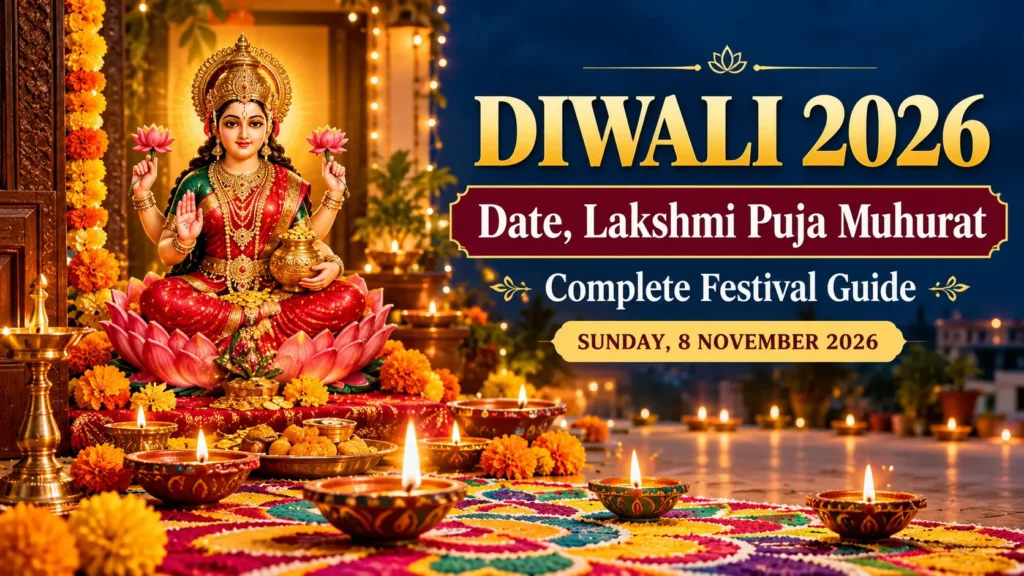
Diwali Festival Guide · 2026
Diwali 2026: Date, Lakshmi Puja Muhurat & Guide
Diwali 2026 falls on Sunday, 8 November, in India. The festival is associated with Amavasya, the new-moon tithi, and many Hindu households perform Lakshmi Puja in the evening. The recommended Puja Muhurat varies by location, so check the timing for your city before making plans.
This guide covers the main Diwali date, city-wise Lakshmi Puja Muhurat, the festival calendar, traditional Puja Vidhi, commonly used samagri, regional customs and practical advice for a safe celebration.
Sunday, 8 November 2026
Lakshmi Puja on Diwali evening
Amavasya, the new-moon tithi
Indian Standard Time (IST)
Diwali 2026: Date and Day
Diwali will be celebrated on Sunday, 8 November 2026, in India. Also known as Deepavali, the Festival of Lights is marked by prayers, lamps, decorations, family gatherings, festive food and the exchange of sweets and gifts.
The main Hindu observance is associated with Amavasya, the new-moon tithi. A tithi is a lunar day calculated from the relative positions of the Sun and Moon. Since Hindu festival dates are based on lunar calculations and observance rules, they do not fall on the same Gregorian date every year.
The name of the lunar month can vary with the calendar convention used in different regions. This is one reason that local Panchang information is useful when checking religious observances. The primary Diwali date for India in 2026 is 8 November, but related rituals can be assigned different dates according to regional practices.
For many families, the highlight is Lakshmi Puja in the evening. The timing is not the same throughout India because sunset, local astrological periods and the Panchang calculation depend on location.
Lakshmi Puja Muhurat 2026: City-Wise Timings
Lakshmi Puja is performed to worship Goddess Lakshmi, who is associated with prosperity and well-being. Many households also worship Lord Ganesha. Families traditionally consult a local Panchang to select a suitable time for the evening observance.
The following reference timings are for Sunday, 8 November 2026, according to city-specific Drik Panchang listings. All times are shown in Indian Standard Time (IST, UTC+5:30). Recheck your local listing before Puja in case your family follows a different regional calendar or calculation method.
| City | Date | Start time | End time | Time zone |
|---|---|---|---|---|
| New Delhi | 8 Nov 2026 | 5:54 PM | 7:50 PM | IST |
| Mumbai | 8 Nov 2026 | 6:27 PM | 8:27 PM | IST |
| Pune | 8 Nov 2026 | 6:24 PM | 8:24 PM | IST |
| Bengaluru | 8 Nov 2026 | 6:17 PM | 8:20 PM | IST |
| Kolkata | 8 Nov 2026 | 5:20 PM | 7:18 PM | IST |
| Chennai | 8 Nov 2026 | 6:07 PM | 8:09 PM | IST |
| Hyderabad | 8 Nov 2026 | 6:07 PM | 8:08 PM | IST |
| Ahmedabad | 8 Nov 2026 | 6:22 PM | 8:20 PM | IST |
Important: These are reference timings from a published Panchang, not a universal instruction for every household. A different almanac may show a small variation. Confirm the local time for the city where you will perform Puja.
What is Amavasya Tithi?
Amavasya is the new-moon tithi in the Hindu lunar calendar. The New Delhi Drik Panchang listing shows Amavasya beginning at approximately 11:27 AM on 8 November and ending at approximately 12:31 PM on 9 November 2026. These are reference times for that listing; the calendar day on which a festival is observed also depends on the applicable observance rules.
What is Pradosh Kaal?
Pradosh Kaal is the period around sunset and early evening. It is relevant to several Hindu observances, including many traditions of Diwali Lakshmi Puja. For New Delhi, the listed Pradosh Kaal on 8 November is approximately 5:31 PM to 8:09 PM.
What is Vrishabha Kaal?
Vrishabha Kaal is a period when Taurus, known as Vrishabha in Sanskrit, is rising on the eastern horizon. Some Lakshmi Puja calculations consider the overlap between this period and the relevant evening window. Its timing varies with location, which is why a city-specific Muhurat is more useful than one nationwide time.
To explore auspicious timings for a date and location supported by the tool, visit the Shubh Muhurat Calculator. You can also consult the Hindu Panchang Calculator for the Panchang information it supports. Always confirm the result with your local calendar and family tradition.
Diwali 2026 Calendar: All Major Festival Days
Diwali is often described as a five-day celebration, but the wider festive period includes additional observances. The dates of some rituals vary by region and Panchang. The table below summarises commonly listed observances for India.
| Date | Day | Festival | Common observance |
|---|---|---|---|
| 5 November | Thursday | Vasubaras / Govatsa Dwadashi | Observed in parts of western India, including Maharashtra, with traditions honouring cows and calves. |
| 6 November | Friday | Dhanteras | Associated with Dhanvantari, household worship and, in many families, buying utensils or precious metals. |
| 7 November | Saturday | Kali Chaudas | A regional observance especially associated with parts of Gujarat and western India. |
| 8 November | Sunday | Naraka Chaturdashi / Chhoti Diwali | Linked with the story of Krishna's defeat of Narakasura and various morning or cleansing traditions. |
| 8 November | Sunday | Main Diwali / Lakshmi Puja | The main Diwali date in India, marked by evening worship, lamps, decorations and family gatherings. Kali Puja is also observed by many communities on this night. |
| 9 or 10 November | Monday or Tuesday | Govardhan Puja / Annakut | The date differs between regional calendars. Some city-specific Panchang listings give 9 November; others place the observance on 10 November. |
| 9 or 10 November | Monday or Tuesday | Bali Pratipada / Bali Padwa | A regional observance associated with King Bali and the Vamana tradition. In Maharashtra, the public-holiday calendar lists Bali Pratipada on 10 November. |
| 10 November | Tuesday | Gujarati New Year / Bestu Varas | The new year in the Gujarati calendar, commonly marked with greetings, temple visits and family gatherings. |
| 11 November | Wednesday | Bhai Dooj / Bhai Bij / Bhau Beej | A family observance celebrating the bond between siblings, often with a tilak and a shared meal. |
Calendar note: Govardhan Puja and Bali Pratipada should be confirmed with the Panchang followed in your region. The dates above describe commonly published observances, not a single universal schedule for every community.
Why Is Diwali Celebrated?
Diwali has several religious and cultural meanings across India. For many Hindus, it is associated with the return of Lord Rama, Goddess Sita and Lakshmana to Ayodhya after Rama's exile and victory over Ravana. In the popular account, lamps were lit to welcome them home.
Other Hindu traditions connect the festival with Lord Krishna's defeat of Narakasura, the worship of Goddess Lakshmi or other stories about the triumph of good over evil. In Bengal and some eastern Indian communities, Kali Puja is an important observance on the new-moon night.
The occasion also has significance in other faiths. Jains associate Diwali with Lord Mahavira's nirvana, while Sikhs commemorate Bandi Chhor Divas, connected with Guru Hargobind Sahib's release from imprisonment and the release of other prisoners.
Although these stories and customs differ, themes of hope, renewal, freedom, gratitude and the victory of good over evil are common in many celebrations. Lighting lamps, offering prayers, preparing festive food and meeting loved ones are ways families express these values.
There is no single story that explains every community's observance, and not every household follows the same rituals. Local history, regional customs and family traditions all influence how people celebrate.
Lakshmi Puja Vidhi: A Simple Step-by-Step Guide
This is a general household guide for people who perform Lakshmi Puja on Diwali evening. Ritual sequences and required offerings differ, so follow your family's custom or consult a trusted religious authority if you need a specific regional Vidhi.
-
Clean and prepare the Puja area.
Choose a tidy, stable place for worship. Arrange a platform and clean cloth if customary, and keep lamps away from paper, curtains and other flammable materials.
-
Arrange the images or idols.
Place the images of Goddess Lakshmi and Lord Ganesha according to your family's tradition. Set out flowers, water and the offerings you plan to use.
-
Prepare the offerings.
Keep flowers, fruit, sweets, rice, kumkum, water and any customary items ready. Not every family uses all of these items, and other regional offerings may be included.
-
Begin with prayers.
Many families worship Lord Ganesha before worshipping Goddess Lakshmi. Offer prayers or devotional songs in accordance with your family's custom.
-
Perform Lakshmi Puja.
Offer flowers and customary items, express gratitude and pray for well-being and wisdom. The specific prayers, mantras and sequence depend on the tradition being followed.
-
Light diyas and perform aarti.
Place lamps securely and supervise children around open flames. Perform aarti if it is part of your practice, taking care that the flame remains clear of decorations and loose clothing.
-
Share prasad and spend time together.
Conclude the worship according to your custom and distribute prasad. Many families then share a meal, visit relatives or enjoy a quiet evening together.
Remember: This is a practical introduction, not a replacement for every regional Puja Vidhi. Follow the practices meaningful to your household.
Lakshmi Puja Samagri List
Preparing commonly used Puja items in advance can make the evening easier. Use this checklist as a starting point and adjust it to your family's customs.
The checklist is provided for convenience. Every item is not compulsory in every tradition.
How to Prepare Your Home for Diwali
Clean and decorate in advance
Finish most cleaning before the main evening so you have time for family responsibilities and Puja preparations. Diyas, flowers, paper lanterns, rangoli and decorative lights can make the home festive without requiring expensive purchases.
Plan sweets and family meals
Prepare or buy sweets and snacks early enough to avoid last-minute pressure. If you plan to visit relatives, confirm arrangements in advance and consider dietary needs, food allergies and safe food storage.
Organise the Puja items
Arrange the worship area, offerings and clean utensils before the selected Muhurat. Checking your local Panchang in advance can reduce confusion when comparing times from different websites.
Celebrate safely
- Keep lit diyas away from curtains, paper decorations and loose clothing.
- Use stable, heat-resistant holders on flat surfaces.
- Never leave an open flame unattended.
- Check decorative electrical lights and avoid damaged wires or overloaded sockets.
- Keep children and pets away from flames and hot surfaces.
- Choose quieter, lower-pollution celebrations when possible and respect neighbours, older people and animals.
A meaningful Diwali does not have to be expensive or noisy. Simple lamps, shared food, prayers and time with loved ones are enough for many families.
How Diwali Is Celebrated Across India
Maharashtra
In Maharashtra, the festive period may include Vasubaras, Dhanteras, Narak Chaturdashi, Lakshmi Puja, Bali Padwa and Bhau Beej. Families may prepare faral, a selection of savoury and sweet snacks, and decorate their homes with kandils, rangoli and lamps. The exact sequence varies by household and regional calendar.
North India
Many families celebrate with Lakshmi-Ganesha Puja, diyas, rangoli, sweets, gifts and visits to relatives. The return of Lord Rama to Ayodhya is an especially familiar part of the festival's popular story in many communities. Govardhan-related observances and Bhai Dooj follow in the wider calendar.
Gujarat
Some Gujarati business communities observe Chopda Pujan, a traditional worship of account books. Gujarati New Year, known as Bestu Varas, is marked with greetings, temple visits and family gatherings. In 2026, Bestu Varas is listed for 10 November.
Bengal and eastern India
Kali Puja is a major observance for many Bengali households on the new-moon night. Homes and temples may be illuminated while worship focuses on Goddess Kali. These traditions coexist with other Diwali practices, and not every household celebrates in the same way.
South India
Naraka Chaturdashi is an important part of Diwali celebrations in several South Indian traditions. Customs may include an early-morning oil bath, new clothes, prayers and festive foods, along with stories of Krishna's defeat of Narakasura. Ritual details vary by family and region.
These examples describe common customs rather than rules followed by every household. Families living outside their home region may adapt traditions or combine practices meaningful to them.
Diwali Traditions: Food, Diyas, Rangoli and Family Celebrations
Diyas are among the best-known symbols of Diwali. Their light is often associated with hope, knowledge and a new beginning. Families may place lamps near entrances, balconies or worship areas, taking care to keep flames away from decorations and combustible materials.
Rangoli designs are created with coloured powders, flower petals, rice flour or other materials. Some designs are simple and geometric, while others use traditional motifs. Making rangoli can also be a shared family activity during the festival preparations.
Food plays an important part in the celebration. Depending on the region, families prepare sweets, savoury snacks, dry fruits and special meals. Maharashtrian faral, Gujarati snacks and regional delicacies across North and South India each have a place in festive gatherings.
People also exchange gifts, visit relatives and reconnect with neighbours and friends. Some use the occasion to donate food, help people in their community or begin the new season with a renewed sense of gratitude and responsibility.
There is no single way to celebrate Diwali. A meaningful celebration can be traditional, simple, community-focused or a combination of customs passed down through generations.
Frequently Asked Questions About Diwali 2026
1. When is Diwali in 2026?
Diwali falls on Sunday, 8 November 2026, in India. The main Hindu observance is associated with Amavasya and includes Lakshmi Puja in many households.
2. What day of the week is Diwali 2026?
The main Diwali date in India is Sunday, 8 November 2026.
3. What is the Lakshmi Puja Muhurat in 2026?
The Muhurat depends on the city and Panchang. The reference timings in this guide are 5:54 PM–7:50 PM for New Delhi, 6:27 PM–8:27 PM for Mumbai and 6:24 PM–8:24 PM for Pune on 8 November. Confirm the final timing for your location before Puja.
4. Are Lakshmi Puja timings the same throughout India?
No. Local sunrise, sunset, astrological periods and Panchang calculations affect the recommended period. Use a reliable listing for the city where you will perform Puja.
5. When is Dhanteras in 2026?
Dhanteras is listed for Friday, 6 November 2026, in commonly used Indian festival calendars. Check a local Panchang if you need the exact observance timing.
6. When is Chhoti Diwali in 2026?
Naraka Chaturdashi, commonly called Chhoti Diwali in many regions, is listed on Sunday, 8 November 2026. Kali Chaudas is listed on 7 November in some regional calendars.
7. When are Govardhan Puja and Bhai Dooj in 2026?
Govardhan Puja is listed for 9 November in some western Indian city-specific calendars and 10 November in other calendars. Bhai Dooj is listed for Wednesday, 11 November. Follow the Panchang used in your region.
8. What items are needed for Lakshmi Puja?
Common items include images or idols of Goddess Lakshmi and Lord Ganesha, a clean platform, diyas, flowers, water, rice, kumkum, fruits, sweets and aarti materials. The exact list varies by family and tradition.
9. Why is Diwali celebrated?
Diwali has several religious and cultural meanings. Many Hindus connect it with the return of Lord Rama to Ayodhya, while other traditions emphasise different stories and deities. Jains associate the occasion with Mahavira's nirvana, and Sikhs commemorate Bandi Chhor Divas.
10. Where can I check auspicious timings and Panchang details?
Consult a reliable, location-specific Panchang and compare it with your family's tradition. You can also check the Shubh Muhurat Calculator and the Hindu Panchang Calculator on TodayFestival.com for the information supported by each tool.
Celebrate Diwali 2026 with Care and Understanding
Diwali falls on Sunday, 8 November 2026, in India. The wider festive period includes Dhanteras, Naraka Chaturdashi, Lakshmi Puja, Govardhan-related observances, regional New Year celebrations and Bhai Dooj.
Before performing Lakshmi Puja, confirm the recommended time with a reliable local Panchang, particularly if you are comparing timings from different cities or calendar traditions. Prepare your samagri in advance, follow the customs meaningful to your family and keep lamps and electrical decorations safe.
May Diwali bring reflection, generosity, happiness and togetherness for you and your loved ones.