SLEEP BETTER, PLAN SMARTER
Sleep Calculator
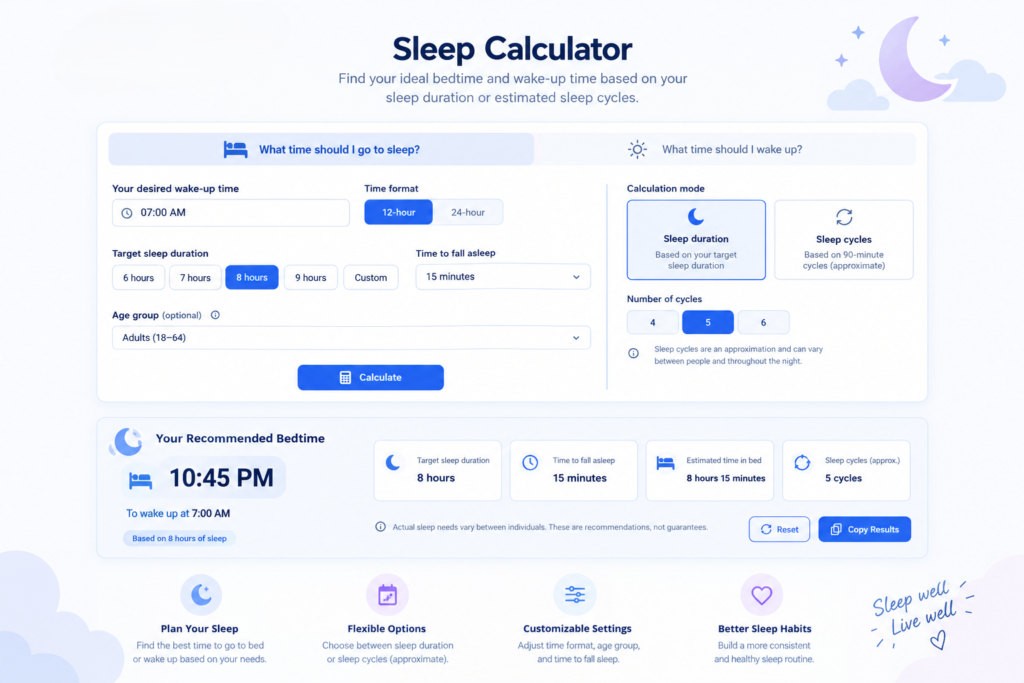
Find a suggested bedtime or wake-up time based on your target sleep duration or an approximate sleep-cycle calculation.
YOUR ESTIMATE
Your suggested bedtime
—
Other options
These are planning estimates, not medical advice. Sleep cycles vary, and the calculator cannot measure your actual sleep stages.
How to Use the Sleep Calculator
- Choose Bedtime if you know when you need to wake up, or Wake-up time if you know when you plan to go to bed.
- Choose a target sleep duration or an estimated number of sleep cycles.
- Set your usual time to fall asleep and optionally select an age group.
- Select Calculate to see a suggested time and alternatives.
How Much Sleep Do You Need?
Sleep needs change with age and vary from person to person. General public-health guidance gives these typical daily ranges:
| Age group | Typical sleep recommendation |
|---|---|
| Young children, 3–5 years | 10–13 hours, including naps |
| Children, 6–12 years | 9–12 hours |
| Teenagers, 13–18 years | 8–10 hours |
| Adults, 18–60 years | 7 or more hours |
| Adults, 61–64 years | 7–9 hours |
| Adults, 65 years and older | 7–8 hours |
These are general recommendations rather than a personal diagnosis. For younger children, age-specific needs, or ongoing sleep difficulties, consult a qualified healthcare professional. Guidance source: U.S. Centers for Disease Control and Prevention (CDC).
Understanding Sleep Cycles
Sleep moves through repeating stages, including non-REM and REM sleep. A cycle is often described as lasting around 90 minutes, but its length can vary between people and across the same night. This calculator uses 90 minutes only as a convenient estimate to plan a schedule.
It cannot tell when you enter a particular sleep stage or guarantee that waking at the end of a calculated cycle will make you feel more refreshed. Learn more from the National Institutes of Health (NIH).
Why Your Time to Fall Asleep Matters
Your bedtime is when you get into bed; sleep onset is when you actually fall asleep. Adding an estimated sleep-onset allowance helps distinguish time in bed from target time asleep. The default is 15 minutes, but your real experience may be shorter or longer.
Tips for a Consistent Sleep Schedule
- Try to keep your bedtime and wake-up time reasonably consistent, including on weekends.
- Create a quiet, dark, comfortable sleeping environment.
- Allow time to wind down before bed and reduce stimulating activities if they affect your sleep.
- Pay attention to how rested and alert you feel during the day, not only to the time on the clock.
- Speak with a healthcare professional if sleep difficulties are frequent or affect your daily life.
Frequently Asked Questions
How many hours of sleep do I need?
It depends on your age and individual needs. Many adults need at least 7 hours, while children and teenagers generally need more. Use the age guidance above as a starting point.
What time should I go to bed if I wake up at 6 AM?
For 8 hours of estimated sleep and a 15-minute allowance to fall asleep, a suggested time to get into bed is 9:45 PM. Your own sleep needs and time to fall asleep may differ.
What time should I wake up if I go to bed at 10 PM?
With an 8-hour target and 15 minutes to fall asleep, the estimated wake-up time is 6:15 AM. This is a calculation, not a guarantee of sleep quality.
Are sleep cycles exactly 90 minutes long?
No. Ninety minutes is an approximation. Actual cycles can be shorter or longer and vary across the night, so cycle-based results should be treated as estimates.
Does the calculator account for time needed to fall asleep?
Yes. You can adjust the sleep-onset allowance. It is added to time in bed, while the target duration represents estimated time asleep.
Is this sleep calculator accurate?
It performs time arithmetic based on the values you enter. It cannot measure actual sleep, determine your individual sleep requirement, or predict sleep quality.
Can I use the calculator in any country?
Yes. It uses time values you enter and lets you choose 12-hour or 24-hour display. It does not require location access or assume a specific time zone.
Is the sleep calculator free?
Yes. The calculator is free to use and does not require an account or personal details.
This tool provides general scheduling estimates for informational purposes only. It is not a substitute for professional medical advice, diagnosis, or treatment.